
Sooner or later, every AI-assisted insurance decision will be questioned. A claimant will ask why their claim was routed for investigation. A broker will ask why a submission was declined. A market conduct examiner will ask how a model influences pricing. An internal auditor will ask how you know the system did what it was supposed to do.
If the answer to any of those questions is “we’d have to ask the data science team,” the AI isn’t audit-ready — no matter how accurate it is.
Explainability in insurance is often discussed as a property of models: interpretable algorithms, feature importance charts, attention maps. Those matter, but they’re only part of the picture. Audit-ready explainability is an operational capability: the ability to reconstruct, for any individual decision, what the system saw, what it concluded, why, and who was accountable — and to communicate that in terms each audience understands.
Different audiences need different explanations
One of the most common mistakes is assuming a single explanation serves everyone. In practice, insurers need at least five.
Claimants and policyholders
They need a plain-language reason for outcomes that affect them, and a route to challenge. “Your claim requires additional review because the reported date of loss is before the policy start date shown on our records. Please contact us if this is incorrect.” Not a score. Not a list of model features.
Brokers and agents
They need actionable reasons: what was missing, what fell outside appetite, what would change the outcome. A decline with a clear, specific reason preserves the relationship. An unexplained one damages it.
Underwriters and adjusters
They need to see the evidence behind a recommendation so they can accept, adjust, or override it with confidence. This means source-linked facts and the specific rule or factor driving each recommendation.
Internal audit, risk, and model governance
They need the full decision lineage: input data, model and rule versions, outputs, thresholds, human interventions, and outcomes. They also need aggregate views — how the system behaves across thousands of decisions, not just one.
Regulators
They need evidence of a governance program: documented policies, model inventories, validation and testing results, fairness assessments, monitoring, and the ability to produce decision-level records on request. The NAIC model bulletin on insurers’ use of AI systems, for example, sets expectations for written AI programs, governance, and documentation; in the EU, the AI Act treats AI used for risk assessment and pricing in life and health insurance as high-risk, with requirements for transparency and record-keeping.
Designing explanations for each audience — rather than hoping one technical output can be translated after the fact — is the first step toward audit readiness.
Build decision records by design
The foundation of explainability is a decision record created at the moment of every AI-assisted decision. Retrofitting this later is expensive and often impossible. Each record should capture:
- Inputs: the data the system used, with references to source documents (the page of the application, the line of the loss run, the specific photo).
- Versions: the exact model, rule set, prompt, and configuration versions in effect.
- Outputs: scores, classifications, recommendations, and confidence levels.
- Reasons: the top factors or rules that drove the output, in structured form.
- Human involvement: who reviewed it, what they decided, and any override reason.
- Outcome: what ultimately happened — paid, declined, bound, referred.
Records should be immutable, time-stamped, and retrievable by claim or policy number. With these in place, explaining a decision becomes a query, not a forensic project.
Prefer transparent logic where stakes are high
Not every component needs to be a complex model. For many insurance decisions, a combination of transparent rules and well-understood models is both more explainable and easier to govern.
- Eligibility and appetite rules should be readable, versioned business rules that underwriting leadership approves.
- Triage and routing can use scores, but the factors should be visible to the handler.
- Generative AI used for summarizing documents or drafting communications should always cite sources and should never be the sole basis for an adverse decision.
When more complex models are used, pair them with explanation methods that identify the drivers of individual outcomes, and validate that those explanations are stable and meaningful — not just mathematically available.
Make explanations testable
An explanation is only useful if it’s accurate. Build tests into your model governance:
- Consistency: do similar cases receive similar explanations?
- Faithfulness: if you change the factor cited as most important, does the outcome actually change?
- Comprehensibility: can a claims handler or underwriter, given the explanation, correctly predict what the system will do on a new case?
- Fairness: are outcomes and reasons reviewed for patterns that could indicate unfair discrimination, using methods appropriate to the line and jurisdiction?
Illustrative example: a carrier using an AI model to flag claims for special investigation might run a quarterly review in which SIU staff are shown the explanation for a sample of flags and asked whether the cited reasons are relevant and sufficient. Flags where staff consistently find the reasons unhelpful become candidates for model or rule revision.
Monitor explanations over time
Models drift, and so do their explanations. A routing model that originally relied on loss type and severity might, after a data change, begin leaning heavily on a proxy variable nobody intended. Monitor the distribution of top reasons over time alongside model performance. Sudden shifts are an early warning sign worth investigating.
Organize for accountability
Explainability fails when nobody owns it. Assign clear roles:
- A business owner for each AI use case, accountable for outcomes.
- A model owner responsible for performance, validation, and documentation.
- A governance function — often within risk or compliance — that maintains the AI inventory, sets standards, and reviews high-risk use cases.
- Front-line reviewers empowered and trained to override AI recommendations, with overrides captured as feedback.
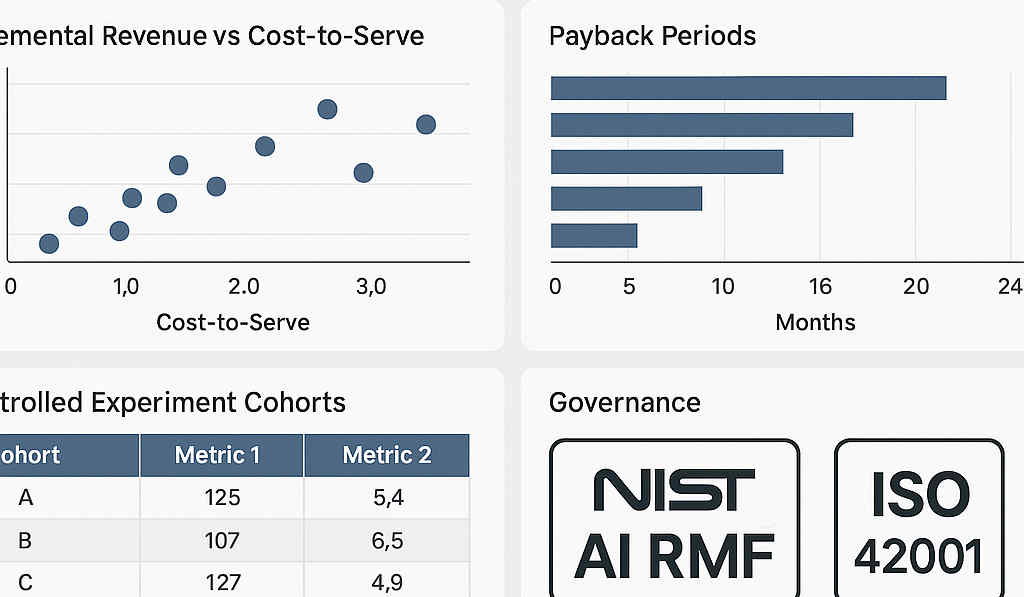
Frameworks like ISO/IEC 42001 and the NIST AI RMF provide useful structures for these roles and processes, and mapping to them helps demonstrate a mature program to auditors and regulators.
The standard: any decision, explained in minutes
The practical test for audit readiness is simple. Pick any AI-assisted claim or underwriting decision from the past year. Can you, within minutes, show what the system saw, what it recommended and why, who reviewed it, and what happened — and explain it appropriately to a claimant, a broker, an auditor, and a regulator?
If yes, you have AI you can accept. If not, that’s where to start.
Check your AI governance against the audit test. Download the Aketud AI Governance Checklist for the decision-record, explainability, monitoring, and accountability controls insurers need to make AI in claims and underwriting audit-ready.